8 August 2026
FRIDA: THE MAKING OF AN ICON
Tate Modern
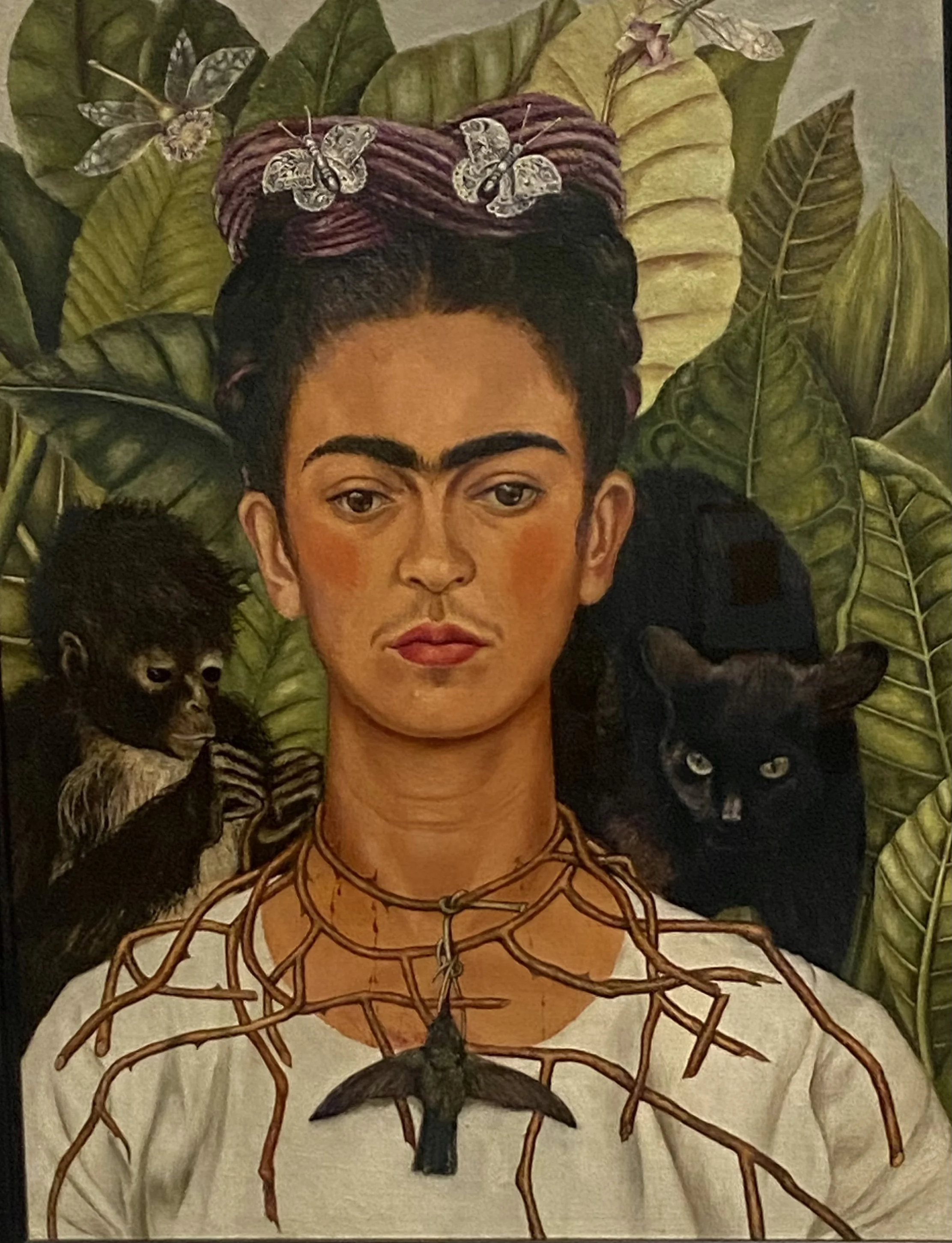
The images and ideas associated with Frida have become almost impossible to separate from the paintings themselves: the flowers, the hair, the jewellery, the Mexican dress, the animals, the intense self-portraiture and that unmistakable gaze. Her visual language has travelled a very long way.
Some of the contemporary responses felt like homage; others seemed to take a fragment of Frida and transform it into something belonging to another artist entirely. That was one of the things I enjoyed most about the exhibition — seeing what other artists had seen in her.
It made me think about the strange life an artwork can have once it leaves the artist. We all look at the same painting differently. One artist might see identity. Another might see the body. Another sees sexuality, politics, pain, resilience or femininity. Someone else might simply see an extraordinary face.
And then they make something of their own. That conversation between artists across generations was, for me, one of the strongest parts of the exhibition. But I couldn’t quite escape the feeling that I wanted to spend more time with Frida herself.
There are moments when the original paintings have an extraordinary presence. You suddenly move from the mythology surrounding her to the actual painter — and the difference is palpable.
I’ve always enjoyed Frida Kahlo’s work. There is something about the directness of her paintings, the intensity of the gaze and the way she turned her own life, body and identity into subject matter that continues to feel remarkably contemporary. So I was interested to see what Tate Modern would do with her.
Frida: The Making of an Icon is, as the title suggests, less a traditional Frida Kahlo retrospective and more an exploration of how Frida became Frida — the artist, the image, the cultural symbol and, ultimately, the icon. And this is where I found the exhibition both interesting and slightly frustrating. I came away feeling that it was rather sparse.
Not necessarily sparse in the number of things on display — there are photographs, personal objects, archival material and works by artists who have been influenced by Kahlo — but sparse in the thing I had really come to see: Frida’s paintings.
The Tate describes the exhibition as bringing together more than 130 works and material from Kahlo’s life, alongside work by more than 80 artists from different generations who responded to her legacy. (Tate Online Shop) But because the exhibition is so concerned with the making of the icon, the experience sometimes feels as though Frida herself is being viewed through a crowd of other people’s eyes.
And perhaps that is precisely the point. There was something fascinating about seeing how differently artists have interpreted her.
That is where I find her most compelling. Because beneath the flowers, the symbolism and the now-familiar image is a painter who made extraordinarily intimate work. Her paintings can feel incredibly still and incredibly direct at the same time. There is no distance between the person looking and the person being looked at. Perhaps this is the problem with becoming an icon. The image becomes bigger than the work.
The exhibition itself seems conscious of this tension. It asks us to think about how Frida’s image has been adopted, reproduced and transformed by generations of people and artists. But walking through it, I sometimes found myself wishing that all the noise could fall away and I could simply stand in front of more of the paintings.
Just Frida. No mythology. No merchandise. No interpretation. Just the work. And perhaps that is also what I took away from the exhibition. An artist’s influence isn’t necessarily about being copied. It can be about what another artist recognises in you — a way of looking, a way of using the body, colour, symbolism or autobiography — and then carries somewhere completely different. That part I found genuinely fascinating. I left the Tate still enjoying Frida’s work, but perhaps even more interested in the strange afterlife of an artist’s image.
How does a painter become an icon?And once they do, can we still see the paintings clearly?
I’m not sure the exhibition completely answered that for me.
But it certainly made me think about it.
And perhaps that is reason enough to go.